|
-Winter Solstice-
Winter starts on
the 21st of December. It is the shortest day of the year and is also
the first day of the new solar year, known as Winter Solstice.
Winter Solstice
(or Yule from Norse meaning wheel) has been celebrated for thousands
of years in Europe. On the 21st of December, the planet Earth is the
farthest from the Sun, which appears at its lowest and weakest. It
is a pivot point from which the light will grow stronger and
brighter, the days stop growing shorter and will slowly lengthen. To
ancient civilisations and beliefs, this particular day marked the
rebirth of Light (the Sun) and the end of Darkness, and was supposed
to hold powerful connections with the worlds of magic and mysticism.
|
 |
 |
|
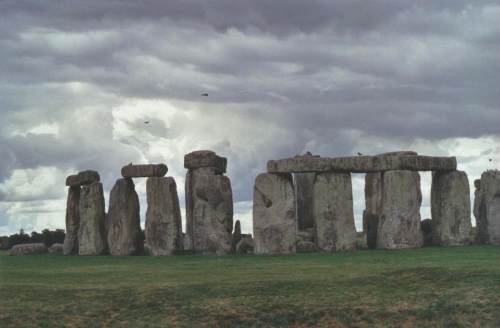
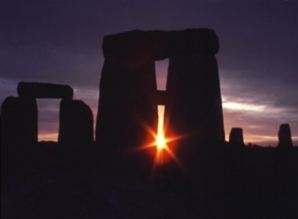
Stonehenge.
It is
thought that Stonehenge dates back thousands of years, to
approximately 2800 BC. No one is quiet sure who
built it or what it's function was. There are many
theories, ranging from an astronomical observatory to
religious temples to a calendar. Stonehenge is angled such
that on the equinoxes and the solstices, the sun rising
over the horizon appears to be perfectly placed between
gaps in the megaliths. |
|
All kinds of rites
and celebrations took place on that special day. In pagan
Scandinavia, great yule logs were burned, people drank mead around
bonfires, listening to minstrel-poets singing ancient legends. It
was believed that the yule log had the magical effect of helping the
sun to shine more brightly. Roman masters feasted with slaves, who
were given the freedom to do and say what they liked.
Mistletoe, which
was sacred because it mysteriously grew on the most sacred tree, the
oak, was ceremoniously cut by Druid priests and a spray given to
each family, to be hung in the doorways as good luck. Mistletoe is
still forbidden in most Christian churches because of its Pagan
associations, but it has continued to have a special place in home
celebrations.
Winter Solstice
has deep connections with our modern 'Winter Feast' : Christams! In
the 3rd century, various dates from December to April, were
celebrated by Christians as Christmas. January 6 was the most
favoured day because it was thought to be Jesus' baptismal day.
Around 350, December 25 was adopted in Rome and gradually almost the
entire Christian Church agreed to that date, which coincided with
Winter Solstice. By 1100, Christmas was the peak celebration of the
year for all of Europe. Many pagan rituals and customs have survived
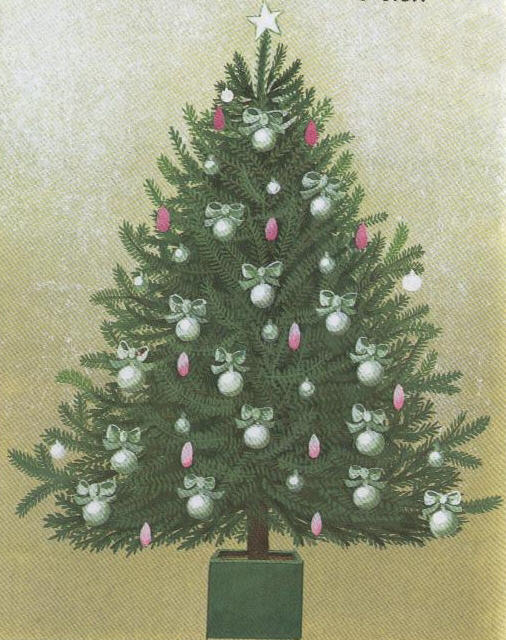
and now belong to Christmas traditions. The Christmas tree is one of
them. It was the time to celebrate the renewal of the earth, and
greens were used as the symbol. Branches of pine, cedar, and juniper
were commonly used to bring wonderful fragrance into the home. Red
candles were used to symbolize the fire and heat of the returning
sun as the days begin to lengthen. |